Site Protection & Access
Crews and equipment mobilized with the driveway, home, existing landscape and neighboring property protected. Access and staging are planned before the first machine moves.
 Start Your Project
Landscape construction / Northern Utah
Excavation, grading, drainage, irrigation and planting across Northern Utah.
Soil, water and plants are what make a built landscape feel finished. They are also the only phase that improves every year after we leave. R2 installs the irrigation and planting together, so what goes in the ground has what it needs to fill in.
 R2 LandscapeDesign · Build · Care
Where projects go wrong
Settling pavers, cracked flatwork, leaning walls, water against the foundation, a lawn that stays wet in one corner all season. These are almost never finish problems. They are sitework problems that were covered up. Northern Utah’s clay soils, rocky fill and freeze–thaw cycles are unforgiving of shortcuts taken in the first two weeks of a project.
What this phase covers
Crews and equipment mobilized with the driveway, home, existing landscape and neighboring property protected. Access and staging are planned before the first machine moves.
Removal of old concrete, asphalt, fencing, sod, rock, stumps and failed hardscape. Everything is loaded, hauled and disposed of, with dump fees carried by us.
Cut, fill and export to bring the site to plan elevation. On-site material is reused where it is suitable and removed where it isn’t. We don’t bury problems to save a haul.
Positive slope established away from the home and structures, low points resolved, and subsurface drainage (French drains, area drains, catch basins) piped to a real discharge point.
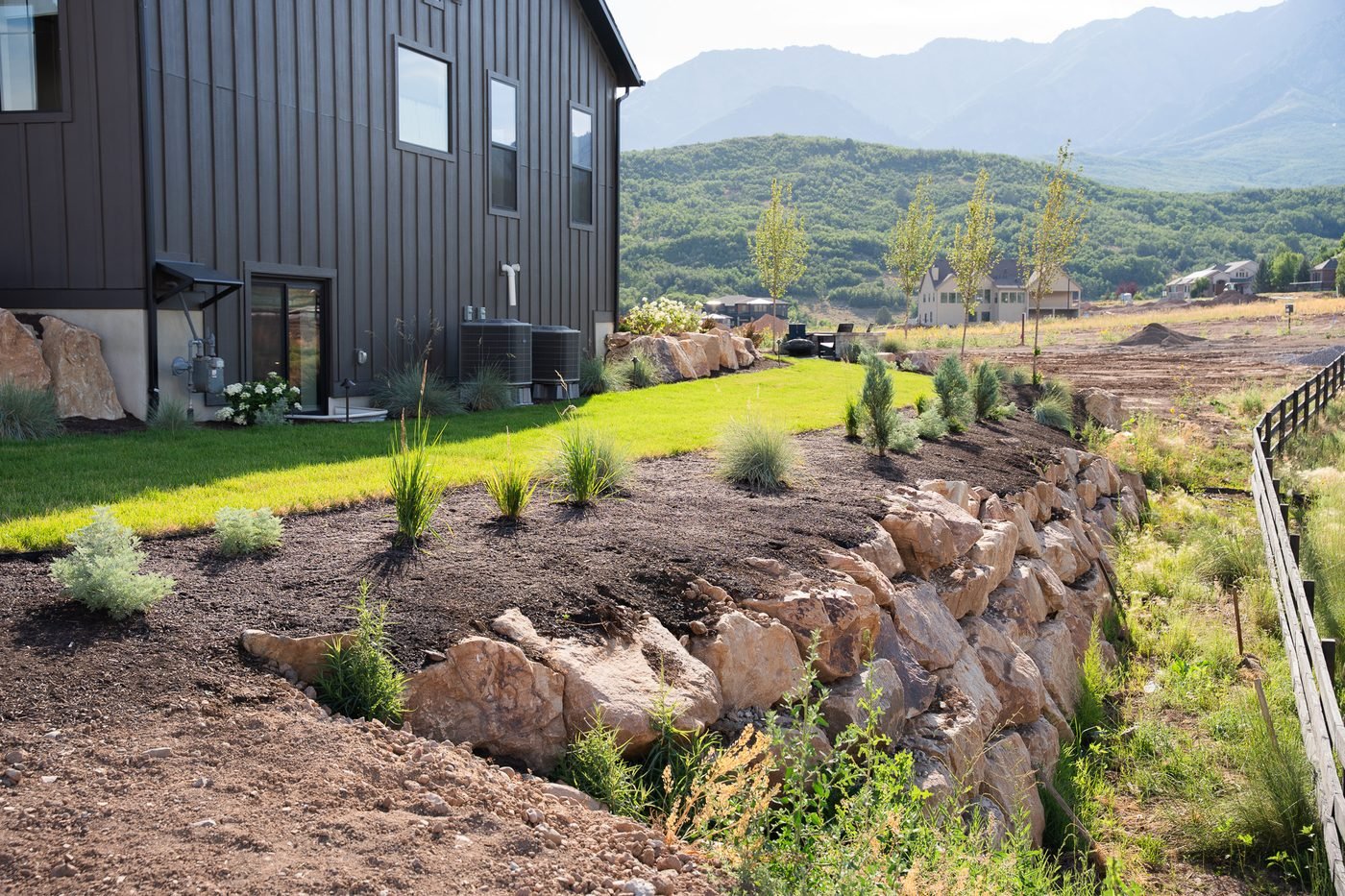
Retaining and boulder walls that make the grade work: engineered base, drainage rock and drain line, geogrid where required, compacted backfill. Engineering coordinated when height or surcharge calls for it.
Trenching for irrigation mains, lighting, gas and electrical sleeves before anything is paved over. Compacted base is then brought to grade so hardscape starts on a tested subgrade.
Why it matters here
Clay that holds water, imported fill of unknown quality, hillside lots, high water tables in the valley and a freeze–thaw cycle that finds every weak base. Northern Utah sites come with real conditions, not generic ones.
Because R2 designs, estimates and builds the whole property, the sitework is planned against the finished landscape from day one. Elevations, drainage paths and sleeve locations are decided while they are still cheap to change, not discovered halfway through.
What this phase is
By the time planting starts, the grade holds, the walls are built, the patios are set and the utilities are buried. This phase covers soil, irrigation, trees, beds and lawn, installed as one system so the property stops looking like a construction site and starts looking like it has always been there.
What we install
Complete systems from the point of connection: mainline, valves, zoned spray and rotor heads, drip to beds and trees, controller and rain sensor, all designed around your water source and pressure.
Finish grading, tilling, and imported topsoil and amendments brought to depth in lawn and bed areas, because Utah clay and construction subgrade will not grow what the design calls for.
Nursery stock selected for Utah hardiness and mature size, set at the right depth and staked where the wind requires it. Each tree is placed for what it becomes, not the size it arrives.
Bed layout and planting built for year-round structure and seasonal color, spaced to fill in properly rather than look full on install day and crowd out by year three.
Lawn areas graded, prepped and installed as sod or hydroseed, shaped to mow cleanly and sized to the water and use it will actually get.
Bark, mulch or decorative rock over weed fabric where appropriate, with steel or concrete edging holding clean lines between lawn, bed and hardscape.
Irrigation
An irrigation system is designed backward from your water: culinary or secondary, the pressure and flow actually available, and the schedule the district allows. Zones are then built so like waters with like: lawn separate from beds, sun separate from shade, drip to trees and shrubs rather than spray that soaks a wall and misses the root ball.
Done that way, the system uses less water, the plants get what they need, and you are not hand-watering the corner the heads never reached. We set the controller, walk every zone with you, and handle winterization and spring startup so the system survives its first Utah winter.
How the phase runs
The site walk confirms elevations and drainage outfalls, locates utilities, and checks access and staging before mobilization.
Demolition, excavation, export and rough grade, run with the site kept clean and the neighbors considered.
Slopes, drainage and compaction are checked and documented before the next phase begins. Nothing gets built on a subgrade we haven’t signed off on.
How we install it
Mainline, valves, laterals and drip are trenched and pressure-tested at rough grade, while the ground is still open and a trench costs nothing to run.
Topsoil and amendments are placed over the system and worked in, finish grade is set, and heads are brought to final grade with every zone tuned for coverage.
Trees, shrubs, beds and lawn go in, mulch and edging finish the lines, and we walk the property with you to go over the controller schedule, watering plan and plant care.
Where we hand off
This is the one phase that depends on what happens after we leave. We install healthy stock, set the water correctly and give you the schedule. From there, the watering, mowing and seasonal care carry it. We’ll tell you exactly what your landscape needs in its first year, and our maintenance team can carry it for you if you’d rather not think about it.
Our work
Common questions
Demolition and removal of what is not staying, excavation, haul-off, rough grading, drainage, and a compacted base ready for whatever is built on top of it.
Because most landscape failures start underground. Water that is not given somewhere to go finds somewhere itself, usually a foundation, a wall or a patio. Grade and drainage are decided first because everything else is built on them and buries them.
Yes. Standing water, water moving toward the house and saturated areas are all grading and drainage problems, and they are solvable without necessarily rebuilding the whole property.
Yes. Irrigation is zoned around your actual water source (culinary or secondary) because the two behave differently on pressure, scheduling and filtration, and a system designed for the wrong one underperforms from the first season.
Culinary is treated drinking water at consistent pressure. Secondary is untreated irrigation water, usually cheaper, often seasonal, and it carries debris that demands filtration and different head selection. Which one a property is on changes how the system is designed.
Yes. Soil preparation, trees, shrubs, beds, mulch and sod. Water goes in first, then plants, because a planting installed ahead of the irrigation that has to keep it alive is a plant on a countdown.
Where we build
Kaysville · Farmington · Bountiful · North Salt Lake · Mountain Green · Morgan · Huntsville · Eden · North Ogden
All service areas ↘Other services
Landscape design · Landscape construction · Site prep & excavation · Retaining walls · Masonry · Hardscape · Outdoor living · Pools
All services ↘Your next step