Landscape construction / Northern Utah
The ground, and
everything that grows in it.
Excavation, grading, drainage, irrigation and planting across Northern Utah.
Landscape construction is the first phase of a property and the last. R2 builds the ground everything sits on, then installs the water and the planting that finish it — same company, right order, nothing handed between trades.
Where projects go wrong
Most landscape failures start underground.
Settling pavers, cracked flatwork, leaning walls, water against the foundation, a lawn that stays wet in one corner all season — these are almost never finish problems. They are sitework problems, and they are expensive to reach once the finishes are on top of them.
What the ground work covers
Ground work. Done once.
Site Protection & Access
Crews and equipment mobilized with the driveway, home, existing landscape and neighboring property protected. Access and staging are planned before the first machine moves.
Demolition & Haul-Off
Removal of old concrete, asphalt, fencing, sod, rock, stumps and failed hardscape — loaded, hauled and disposed of, with dump fees carried by us.
Excavation & Earthwork
Cut, fill and export to bring the site to plan elevation. On-site material is reused where it is suitable and removed where it is not. We do not bury problems to save a haul.
Rough Grading & Drainage
Positive slope established away from the home and structures, low points resolved, and subsurface drainage piped to a real discharge point.
Grade Structures
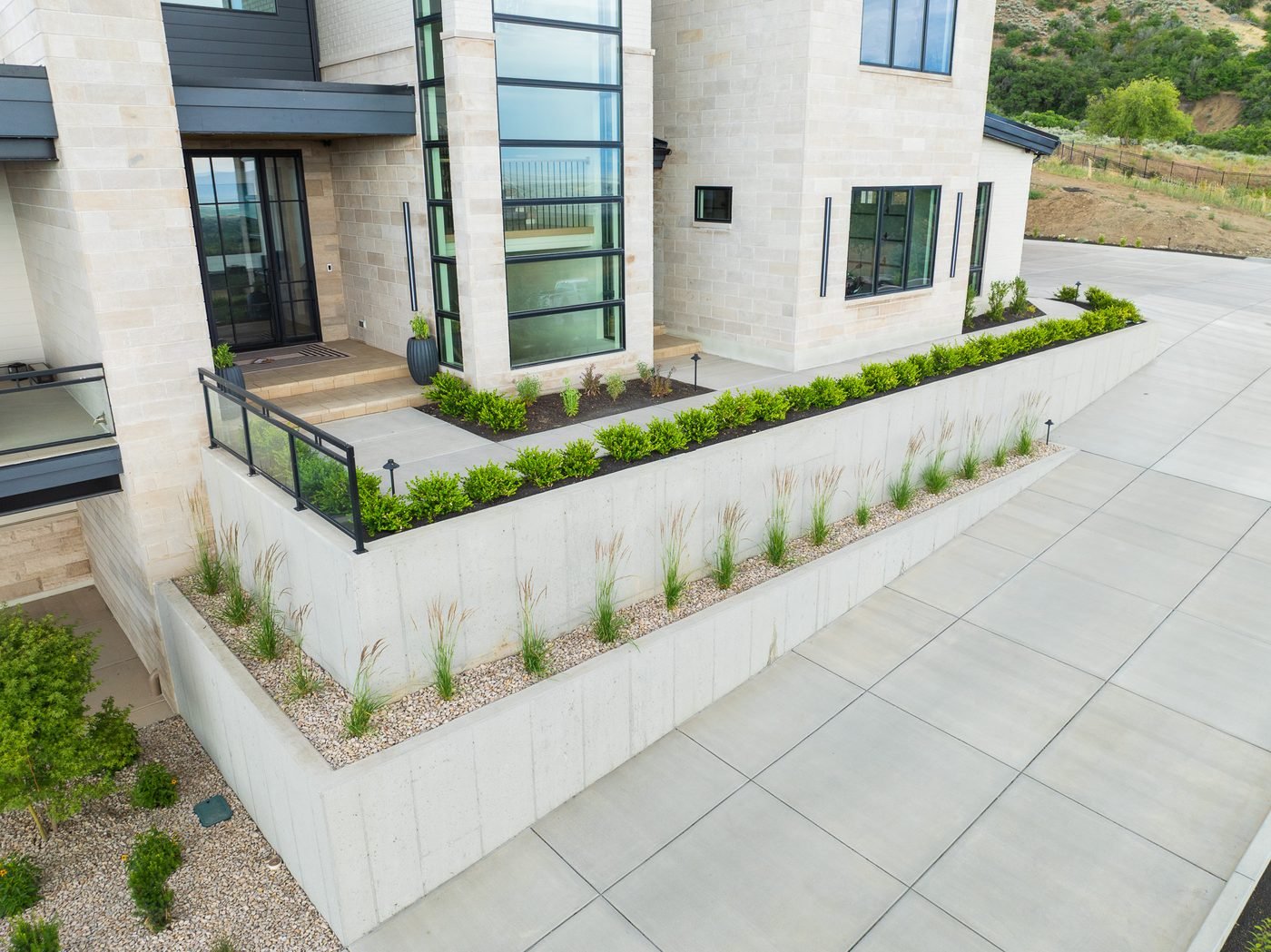
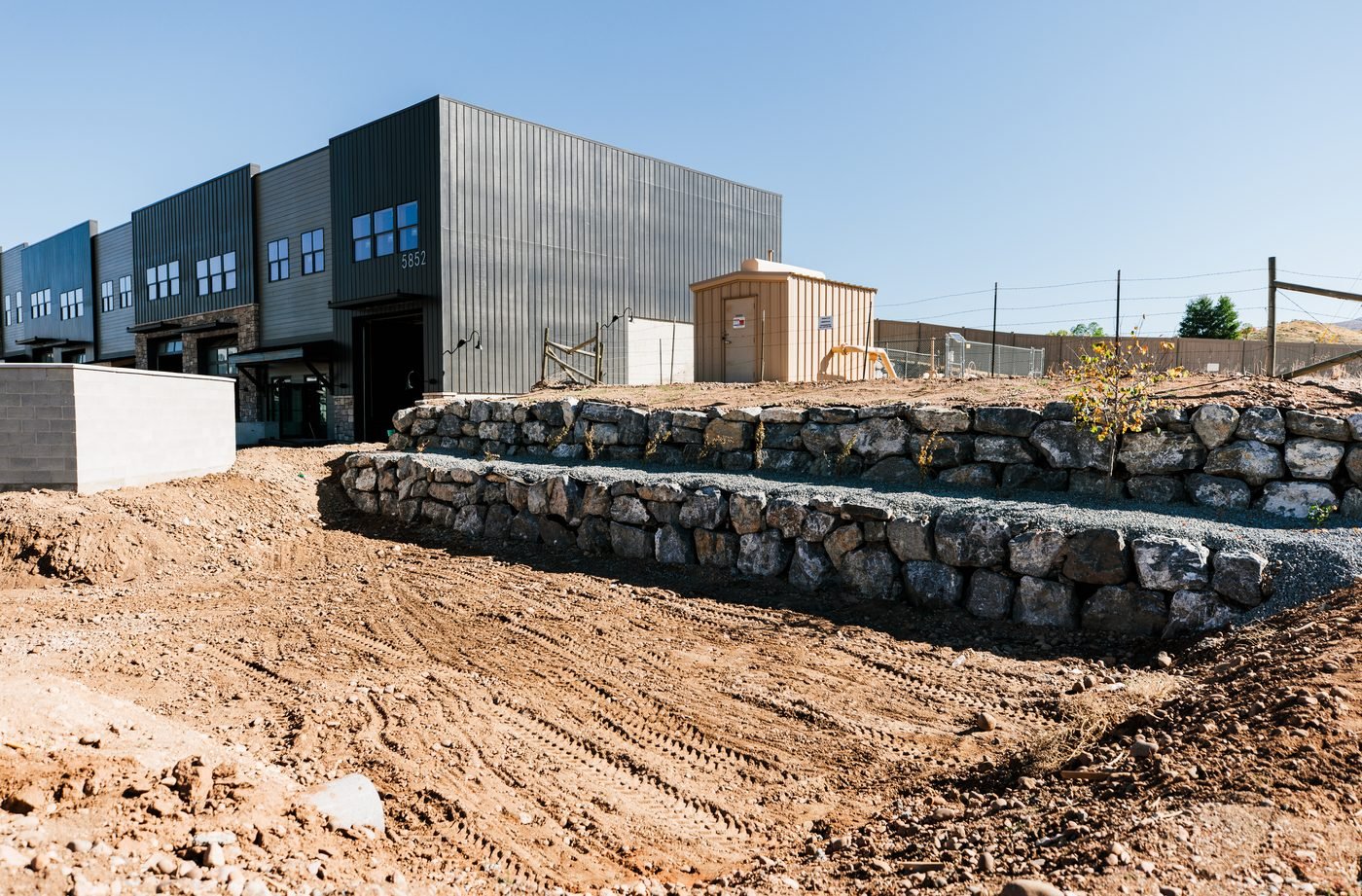
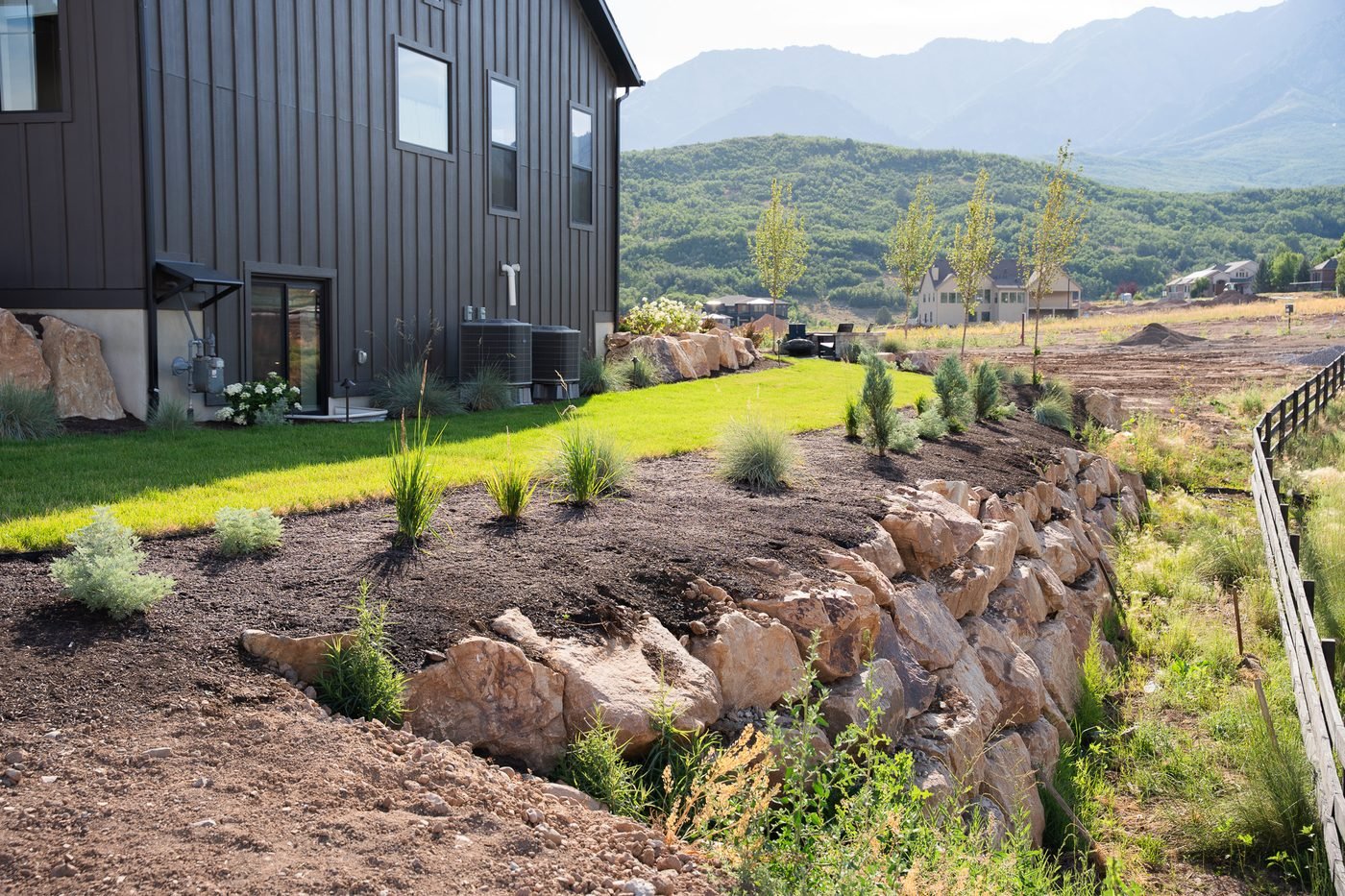
Retaining and boulder walls that make the grade work: engineered base, drainage rock and drain line, geogrid where required, compacted backfill.
Utilities, Sleeves & Base Prep
Trenching for irrigation mains, lighting, gas and electrical sleeves before anything is paved over, then compacted base brought to grade.
Why it matters here
Utah ground has opinions.
We plan around them.
Clay that holds water, imported fill of unknown quality, hillside lots, high water tables in the valley and a freeze-thaw cycle that finds every weak base. Because R2 designs, estimates and builds the whole property, elevations, drainage paths and sleeve locations are decided once, against the finished landscape, rather than discovered later.
The other end of the build
Then everything living.
By the time planting starts the grade holds, the walls are built, the patios are set and the utilities are buried. This phase covers all of it — soil, irrigation, trees, beds and lawn — and it is the only part of a property that improves every year after we leave.
What we install
Soil, water, and
everything living.
Irrigation Systems
Complete systems from the point of connection: mainline, valves, zoned spray and rotor heads, drip to beds and trees, controller and rain sensor, designed around your water source and pressure.
Soil Preparation & Topsoil
Finish grading, tilling, and imported topsoil and amendments brought to depth in lawn and bed areas, because Utah clay and construction subgrade will not grow what the design calls for.
Trees
Nursery stock selected for Utah hardiness and mature size, set at the right depth and staked where the wind requires it. Placed for what the tree becomes, not the size it arrives.
Shrubs, Perennials & Beds
Bed layout and planting built for year-round structure and seasonal colour, spaced to fill in properly rather than look full on install day and crowd out by year three.
Sod & Seed
Lawn areas graded, prepped and installed as sod or hydroseed, shaped to mow cleanly and sized to the water and the use it will actually get.
Mulch, Rock & Edging
Bark, mulch or decorative rock, with steel or concrete edging holding clean lines between lawn, bed and hardscape.
Irrigation
Water is a system,
not a set of sprinklers.
A system is designed backward from your water: culinary or secondary, the pressure and flow actually available, and the schedule the district allows. Zones are then built so like plants are watered together. Done that way the system uses less water, the plants get what they need, and you are not hand-watering the corner the heads never reached.
The sequence
Six steps, in this order.
Verify
We walk the site, confirm elevations and drainage outfalls, locate utilities, and confirm access and staging before mobilization.
Move Earth
Demolition, excavation, export and rough grade, run with the site kept clean and the neighbours considered.
Prove Grade
Slopes, drainage and compaction are checked and documented before the next phase begins. Nothing gets built on a subgrade we have not signed off.
Install Irrigation
Mainline, valves, laterals and drip are trenched and pressure-tested at rough grade, while the ground is still open and a trench costs nothing to run.
Prep the Soil
Topsoil and amendments are placed over the system and worked in, finish grade is set, and heads are brought to final grade with every zone tuned for coverage.
Plant & Finish
Trees, shrubs, beds and lawn go in, mulch and edging finish the lines, and we walk the property with you: controller schedule, watering plan and plant care included.
The right fit
For properties where the ground
has to be right the first time.
Our work
Built, not rendered.
Common questions
Before you
reach out.
What does site preparation include?
Demolition and removal of what is not staying, excavation, haul-off, rough grading, drainage, and a compacted base ready for whatever is built on top of it.
Why does grading matter so much on Utah properties?
Because most landscape failures start underground. Water that is not given somewhere to go finds somewhere itself, usually a foundation, a wall or a patio. Grade and drainage are decided first because everything else is built on top of them.
Do you handle drainage problems on existing landscapes?
Yes. Standing water, water moving toward the house and saturated areas are all grading and drainage problems, and they are solvable without necessarily rebuilding the whole property.
Do you install sprinkler systems?
Yes. Irrigation is zoned around your actual water source, culinary or secondary, because the two behave differently on pressure, scheduling and filtration, and a system designed for the wrong one underperforms from day one.
What is the difference between culinary and secondary water?
Culinary is treated drinking water at consistent pressure. Secondary is untreated irrigation water, usually cheaper, often seasonal, and it carries debris that demands filtration and a different design.
Do you install sod and trees as well?
Yes: soil preparation, trees, shrubs, beds, mulch and sod. Water goes in first, then plants, because a planting installed ahead of the irrigation that has to keep it alive is a plant on a clock.
Tell us about the property. We’ll walk it with you, at no cost.
Start Your Project ↗